CPA vs RevShare vs Hybrid: Which Deal Fits the Traffic You Actually Have
A CPA pays once. A percentage keeps paying, so for every player there is a month where the second overtakes the first, and retention decides where that month lands. Here is how to find it, what one whale does to it, and why CPA belongs in your first quarter and not your third year.

A CPA pays once, a percentage keeps paying, so for every player there is a month where the second overtakes the first. Retention decides where that month lands, not the headline rate. Hybrid buys you cash flow, and you pay for it somewhere in the terms, usually in a clause nobody reads out loud. Take CPA for your first quarter. Then stop taking it by reflex.
Most CPA versus RevShare arguments are two people with different traffic shouting past each other. The media buyer needs the money back this week, because the card statement doesn't care about lifetime value and the campaign dies on Friday without it. The SEO who owns a three-year-old comparison page has every reason to want the tail. Both are right. The answer just doesn't travel between them.
One position up front, so you can argue with it while you read: CPA is the correct default for exactly one quarter, and every quarter after that it quietly costs you money you never see arriving.
What each model pays, and when
CPA pays a fixed amount for each qualifying first-time deposit. Once. Never again for that player. On the published ladder that's $125 at Bronze and $325 at Diamond. The player can keep depositing for three years afterwards and none of it reaches you.
RevShare pays a percentage of what the operator keeps from that player, every month they play: 25% on Trial, 55% at Diamond. The word doing the work there is keeps. It pays on net gaming revenue, after bonuses, payment costs and processing fees come out, which is where most of the disappointment in this industry lives.
Read what NGR and negative carryover mean before you sign anything with a percentage in it.
Hybrid pays a CPA on the deposit and a percentage after it. Simple mechanic. The cost hides in the rates, and that gets its own section below.
Timing separates them too. A CPA lands when the FTD is confirmed, sits as pending, and clears to available on the 15th like everything else here, while RevShare accrues per period, so month one on a new brand looks like nothing and month six looks like a business. If an acronym is doing too much work, the glossary takes two minutes.
The break-even month
Worked example, invented to show the shape, not measured from anything.
Take the top of the ladder, where both numbers are published: $325 CPA, or 55% RevShare. Say a player throws off $100 of NGR a month. Your percentage on that is $55. Divide. The lines cross somewhere in month six, and for the five months before that the CPA player is ahead, which happens to be exactly the stretch of time a media buyer lives inside and a content site never notices. Then it stops being close, because that $325 was paid once, in month one, and the percentage hasn't finished.
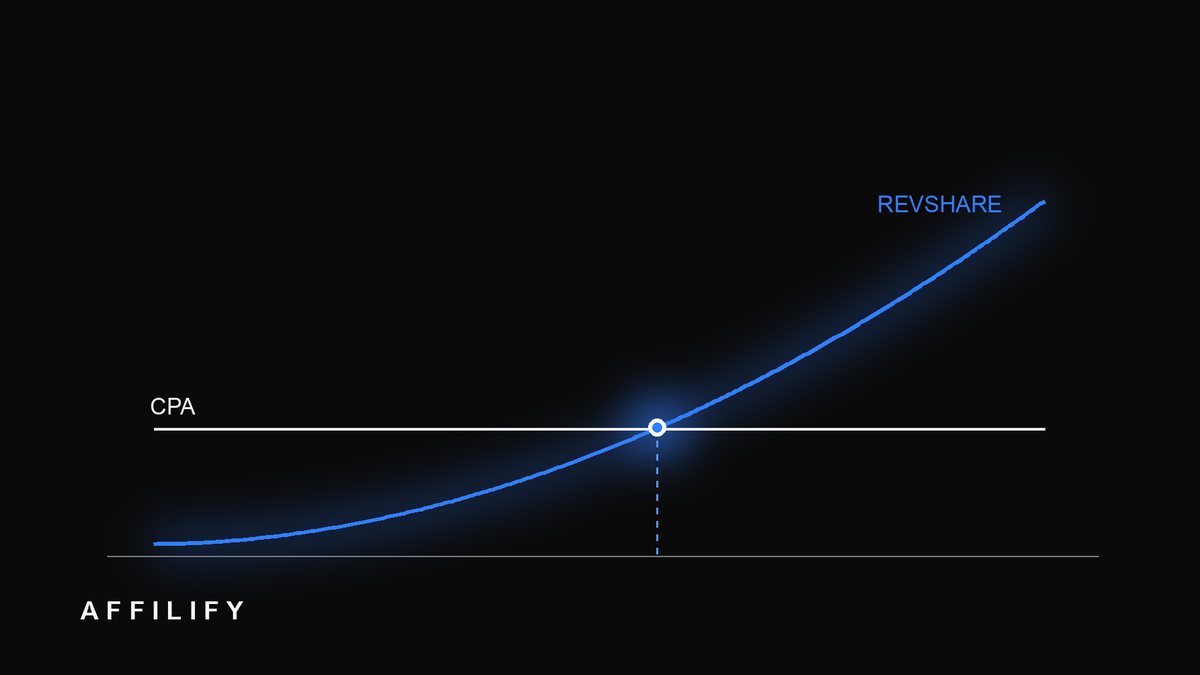
Now change the player instead of the tier. A $40-a-month player pays $22 on the same 55%, and break-even slides out past month fourteen. A $300-a-month player pays $165 and clears the CPA in month two. Same deal, same ladder.
Climbing the ladder raises both halves, the CPA and the percentage together, so a promotion changes the size of the numbers and not the shape of this decision.
Player quits after eight weeks and CPA wins permanently. Player still depositing in month twelve and the percentage has paid several times the CPA with no end written in. Which makes this a retention question wearing a commission question's clothes. Almost nobody can answer that in month one. They pick anyway.
Bonus hunters and real depositors
A bonus hunter deposits the minimum, clears the offer, takes what they can and leaves. Under CPA, if that player scrapes past the qualifying threshold, you collect the full $125 for someone the operator would rather never have met. That isn't a win. It's a bill with a delay on it, which is why CPA deals carry baselines, qualification rules, reversal windows and audits, and why a perfectly good offer gets pulled the week a traffic source goes bad. Under RevShare the same player is worse than free: the bonus comes out inside NGR, so a handful of them can drag your month negative on their own.
Flip the player and the answer flips. Someone who quietly stakes $50 a week for a year is a rounding error under CPA and the best asset on your account under RevShare. One traffic source produces both kinds, often in the same week. Volume, or quality: you're picking the one your traffic makes more of, whether or not you've looked.
Forty small players, or one whale
Forty small players behave like a statistic. Bad weeks cancel good ones, NGR stays inside a range you can plan around, and a percentage on that traffic pays out something close to a salary. One whale behaves like weather. A single VIP can out-earn a year of your CPA volume on a percentage deal, the same person can take a month deep into negative NGR alone, and where negative carryover applies that hole follows you into the month after. Crude test: if you can't say what share of last month's revenue came from your single best player, you're carrying variance nobody has priced.
| Model | Cash now | Ceiling | Where it fails |
|---|---|---|---|
| CPA | Paid on every confirmed FTD | The payout itself | Qualification clauses, reversals, a deal pulled without notice |
| RevShare | Nothing worth counting for months | None | One winning player, then carryover |
| Hybrid | Enough to keep buying | Capped in front, open at the tail | Whichever rate got cut to fund the other |
What hybrid solves, and what it costs
Hybrid solves cash flow, not risk. You take money at the deposit to fund the next batch of traffic and you keep a share of the tail, so a player who turns out to be good isn't lost to you forever.
What it costs depends on who you're dealing with. Across most of this industry hybrid is where the operator takes the difference back, so the check is worth ten seconds of your life: put the hybrid CPA next to that brand's pure-CPA number, and the hybrid percentage next to its pure-RevShare one. If either is smaller, you've found the price. If neither is, go and read the qualification window, because a window stretched until fewer players clear it costs you the same money without ever showing up in a rate. That clause is the negotiation. Nobody volunteers it.
We publish the hybrid line on the same tier ladder as the other two, at the tier rates rather than a trimmed version of either, and each brand's deal states its own terms before you send a single click. Run the ten-second check on it rather than taking that on trust.
Pick by the traffic you have
- SEO and content. RevShare, and it isn't close. Your page keeps ranking for years and those players keep depositing, so a one-off payment throws away the exact thing that made the work worth doing. The only case for CPA here is a brand you doubt will exist in eighteen months, and that doubt is worth acting on in other ways too.
- Paid media. Take the CPA. Month-six money can't pay for Tuesday's campaign, and hybrid only earns a place once a brand has proved it pays when it says it will.
- Telegram and communities. Usually RevShare. You keep the audience and can wake it up again, and people who joined for the game behave nothing like people who came for a coupon. If your members evaporate inside a week, you're a media buyer using a chat app.
- Streamers. Hybrid, and this is the one place it's obviously right rather than a compromise: the audience is loyal enough to justify a percentage, but it plays in bursts around your schedule, and the fixed half keeps paying through a quiet fortnight.
- Incentivized and app traffic. Ask for CPA, and expect most brands to say no. A percentage on this traffic pays close to nothing, because a player who came for the reward behaves like it in the NGR.
What to ask for, per model
- On CPA, get "qualifying" defined in numbers: minimum deposit, how long the player has to make it, the reversal window, and which GEOs the headline rate actually covers.
- RevShare deals turn on the deduction list, so ask for it in writing. Bonuses and payment costs are standard. Everything after that is a choice somebody made, and somebody can be asked to defend it.
- On hybrid, one question does most of the work: which of the two rates was cut to pay for the other, and by how much? If the answer is "neither", the cost is sitting in the qualification clause and you haven't found it yet.
- Then, on any deal at all: what happens when you outgrow the published rate. Per-affiliate overrides sit on top of the program default here, and standout partners negotiate on top of their tier.
Why everyone here starts on RevShare
You don't get to pick your model on day one. Every account starts on the RevShare Trial at 25%, and we open CPA and hybrid at Bronze, after ten qualifying deposits and an admin review that the level ladder sets out in full.
The part worth stealing is what the sequence does for you. Trial is a measuring window. By the time Bronze opens you'll have watched at least ten real depositing players on a percentage deal, which is the only honest way to find out whether your traffic sticks, and it's data you can't buy back later if you spend the whole first quarter collecting a fixed fee and learning nothing about the players behind it. Clear the gate first, inside 30 days if you're organised about it, then choose with numbers instead of preferences.
Stop defaulting to CPA
Newcomers take CPA because it feels safe, and for a first quarter that's usually correct. No retention data, cash going out on traffic every week, and a fixed number per FTD is the only thing you can plan against. Fine. Take it.
Then the habit sets. CPA has a ceiling welded into it, and the ceiling is the payout itself. Do the arithmetic at the top of the ladder: a hundred qualifying FTDs in a month at $325 is $32,500, and that's the end of the sentence, forever, no matter how those hundred players behave for the next four years. The same hundred on 55% of what they generate has no ending written into it at all. Almost nobody stays on CPA because they ran that comparison. They stay because the first number arrives sooner.
The answer is a split, and it's an unglamorous one: CPA on the traffic you can't vouch for, RevShare on the traffic you own, per brand, on one account, since your level is platform-wide and doesn't care which model each brand runs. Two quarters of that and your own numbers will tell you which side each channel belongs on. Nobody else's can.
Frequently asked questions
Is CPA or RevShare better for casino affiliates?
One thing decides it: how long your referred players keep depositing. CPA wins on traffic that converts once and vanishes, which covers most paid media and nearly all incentivized sources. RevShare wins on SEO, content and community traffic that keeps producing month after month. In your first quarter, before you have retention data, CPA is the safer read of a situation you can't measure yet. After that, taking CPA by reflex hands away the tail on your best traffic. That's the position this article defends.
How long does it take for RevShare to beat a CPA?
Divide the CPA by what the same player would pay you each month on the percentage. As an illustration only: a $325 CPA at Diamond against 55% of a player producing $100 of NGR a month is $325 against $55, so the lines cross around month six. Halve that player's monthly value and break-even lands around month twelve instead. Climbing tiers raises the CPA and the percentage together, so your level isn't what decides this. The player's monthly value is.
What is a hybrid affiliate deal?
A hybrid pays a CPA on the first-time deposit plus a revenue share on that player afterwards. It solves cash flow rather than risk, and the cost usually sits in a reduced rate on one of the two halves, or in a qualification window long enough that fewer players ever clear it. Ask which side was cut before you sign. If the answer is neither, the price is hiding in the qualification clause.
Why can I not choose a CPA deal when I sign up to AFFILIFY?
Every account starts on the RevShare Trial at 25%, and CPA and hybrid open at Bronze after ten qualifying deposits and an admin review. That gate is a fraud control, not a sales funnel. A fake player only has to deposit once to trigger a fixed CPA payout, which is why the fixed-fee models sit behind a record of real, verified depositors. Nothing is lost in the meantime. Trial earnings are real earnings, not a demo, and those first ten depositors are the retention data you'll use to pick a model at Bronze.
More from this cluster
When to Ask for a Better Affiliate Deal
Volume, quality, exclusive: three reasons a brand might actually move. How to time the ask, what to put in writing, and the asks that get you ignored.
Sub-IDs for Split Testing: Ten Slots, Used Properly
A tracking link without sub-ids tells you that traffic arrived. A tracking link with sub-ids tells you which headline, which GEO split, which creator and which landing produced the FTD. Ten slots, what to put in each, and the mistakes that make the report unreadable.
Restricted Traffic Sources: What Closes an Account, and What Does Not
Three tiers of traffic source: generally accepted, needs written permission per brand, and never. Almost every lost deal happens in the middle tier, where somebody read silence as a yes. Brand bidding and incentivized traffic explained properly, plus what a reversal actually costs.