FTD, NGR, CPA, CPL, CPR: The Glossary That Decides What You Get Paid
Thirty-two terms grouped by where they sit between a click and a payment, each defined tightly enough that a finance team would sign off on it. Most affiliate disputes start life as a definition nobody checked, so every entry says what the word does to your money.
Most affiliate disputes are vocabulary problems that surfaced too late. FTD, qualifying deposit and baseline are three different things, and one deal can define all three in ways that don't overlap. NGR is not GGR. Pending is not available, and a hold is not a refusal. Get the definitions in writing before you send a click, because after the invoice arrives you're negotiating, not clarifying.
Picture the argument, because sooner or later you'll have it. Your dashboard counted forty first-time deposits in October. The statement pays on thirty-one. Nobody lied. The deal said "qualifying deposit", nobody asked what the qualifier was, and the two of you spent a month counting different things.
Fraud gets the forum threads. But most of the money that goes missing in this business goes missing in the gap between two people using the same word for different things, and closing that gap costs one email, sent before you promote rather than after you invoice.
So this is a glossary with a bias. Each entry says what the word does to your balance rather than what it means in the abstract, and the thirty-two of them are grouped by where they sit between the click and the payment. If you want the map this thing is annotating, start with how the business actually works.
Traffic and tracking
- Click id. The token created at the moment of the click, appended to the destination URL under the operator's own parameter (aff_click by default here) and handed back on the conversion. Everything else in this section is a fallback for when this one goes missing.
- Sub-id. Your own labels, carried through the link and returned with the conversion. Ten slots. Without them you know you earned $900 last week; with them you know which placement earned it, which is the difference between running a business and watching one.
- Tracking link. The URL that carries your click id, built from brand, GEO and landing page. Reach the operator by any other route and the click never happened. Neither did your commission.
- Landing page. The operator page your click id lands on. Two landings for one brand can run different bonuses, which moves both your registration rate and the NGR your RevShare pays on.
- Postback (S2S). A call from the operator's backend to ours, reporting an event: registration, ftd, deposit, ngr. It never touches the visitor's browser. Ask a new partner whether they fire postbacks or pixels, then listen for the hesitation.
- Pixel. A conversion signal fired in the browser, on the operator's page. Ad blockers eat it. Safari's tracking prevention eats more of it. What survives is a quiet discount on your real payout, and the size of that discount is invisible to you by design.
- Deep link. A tracking link aimed at the registration form, one game, one promotion, instead of the homepage, click id still attached.
- Cookie window. How long a click stays attributable through a stored cookie. It matters less than the forums think, because a click id that round-trips doesn't need it. The order of signals here: click id, player token, link code, cookie, fingerprint.
- Device fingerprint. Device and browser characteristics combined into one signal, computed by the bridge redirect (the /go/ link) before it hands the visitor over. Last resort for attribution once the cookie is gone. It's also a fraud signal, which is the half affiliates forget: one device sitting behind six accounts is a pattern, not a coincidence.
What counts as a conversion
These are the events that move money, roughly in the order they happen.
- Registration. A referred visitor opens an account. No money has moved yet. When registrations pile up with nothing behind them, the usual cause is payment friction in that GEO rather than bad traffic, and the fix is a brand whose cashier supports what people there actually pay with.
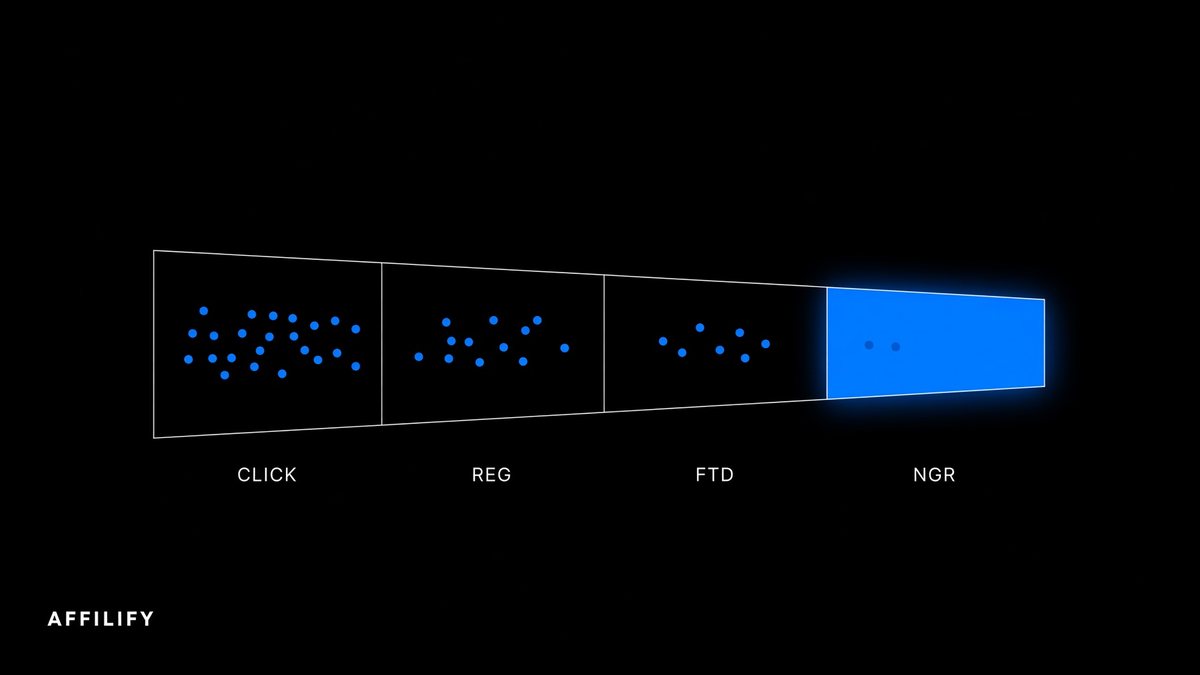
- FTD. First-time deposit. The first real-money deposit a referred player ever makes with that brand, one per player, ever, no matter how many times they come back afterwards. Any deal quoting CPA per FTD needs one follow-up question: any first deposit, or only the qualifying kind?
- Qualifying deposit. An FTD that also clears the deal's conditions: a minimum amount, an accepted payment method, an approved GEO, sometimes wagering the money before it counts. This is where forty becomes thirty-one. Our Trial gate counts ten of them, and the qualifier sits in the deal before you promote instead of being decided once the month has closed. Week by week, that first ten.
- Redeposit. Every deposit after the first one. CPA pays once per player, so redeposits never trigger it. They are the entire RevShare business.
- Lead (CPL). A non-depositing action that pays a fixed amount, usually a registration plus something extra: a verified phone number, a confirmed email, a completed profile. The money arrives fast. The quality clauses are tight, and those clauses are the whole negotiation.
- CPR. Cost per registration, a flat fee for a completed sign-up. Some programs use CPR and CPL to mean the same thing and some use them to mean different things, so the acronym on its own tells you nothing. Make someone write down the exact actions that trigger payment. That list is the deal. The label is decoration.
- Baseline. The floor a deal assumes before its headline rate applies: a minimum number of FTDs a month, a minimum average deposit, sometimes a quality score whose formula you never get to see. Miss it and the rate steps down, or the deal ends. Nobody asks about this one until the month they miss it.
The money words
- GGR. Gross gaming revenue: total bets minus player winnings. The raw house result from your players, before any of the cost of producing it.
- NGR. GGR minus the deal's deductions, typically bonuses, payment processing, gaming taxes and platform fees. RevShare pays on this number, not on GGR and certainly not on deposits, which is why the deduction list matters more than the percentage: two programs both advertising 40% can pay very different money on identical traffic. The full breakdown.
- RevShare. A share of the NGR your players produce, for as long as the deal runs. We publish the ladder instead of negotiating it in the dark: 25% on Trial, 55% at Diamond, every step in between.
- CPA. One fixed payment per qualifying player. $125 at Bronze, $325 at Diamond. Predictable, capped, and completely indifferent to what the player does after the deposit clears. Which model fits your traffic is a separate argument, and a longer one.
- Hybrid. A smaller CPA up front, plus RevShare on the same player afterwards.
- Negative carryover. Your players win more than they lose, NGR goes negative, and the deficit carries into the following month, where future revenue has to repay it before RevShare starts paying again. One VIP on a hot streak can own your quarter.
- Hold period. The stretch between a conversion being reported and the money becoming releasable, while the deposit is verified and the reporting reconciled. Nobody is punishing you. That window is where chargebacks and bonus abuse surface, and a program with no hold at all hasn't thought about either of them.
- Pending versus available. Pending is earned but not cleared. Available is cleared and withdrawable, and here that flip happens on the 15th, with anything sitting under an open investigation clearing when the investigation does. KYC comes before the first payout, not the tenth. The whole pipeline.
- Chargeback and clawback. A chargeback is a deposit reversed at card or bank level, so the transaction that earned you money has stopped existing. The clawback is the commission reversal that follows it. Both are legitimate. What isn't legitimate is either one arriving without a line item naming the conversion and the reason, and a balance that drops silently is the thing you escalate that day, not next quarter.
Risk, quality, and who eats the loss
Two of these are things you can do wrong. Three are how a program decides your traffic is real. The last two happen to you, and the difference decides who absorbs the cost.
- Bonus hunter. Deposits the minimum, claims the welcome bonus, disappears. Registers as a perfectly clean FTD and then flattens the NGR behind it. Under CPA the operator absorbs that. Under RevShare you do.
- Incentivized traffic. Users paid, rewarded or gamified into registering. If a deal has a fair-play clause, this is in it. The ban is the right call: paid registrations convert beautifully for a week and then die, which is the exact shape of fraud even when nobody intended any.
- Brand bidding. Buying search ads on the operator's own brand name. The conversions look cheap. They aren't: the operator is paying you for players it already had. It's also the fastest way to lose a deal you spent months earning.
- Velocity. Rate-based scoring: how many clicks, registrations or deposits arrive from one source, device or IP inside a window. Human traffic has messy timing. Scripts don't.
- Proxy and VPN detection. Flagging clicks routed through anonymizing infrastructure. Alone it proves nothing: plenty of people run a VPN to watch television from another country. So it's weighed with velocity and device signals, never read as a verdict.
- Device correlation. Matching device signatures across accounts to find one person running many players, or many accounts. A ban here cascades to every account on the same hardware. The IPs behind it are stored hashed, not in the clear.
- Shaved traffic. The abuse running the other way: conversions that happened and were never reported, so no commission was ever owed. You catch it by comparing your own click and registration counts against reported conversions, GEO by GEO and month by month, looking for a gap that only ever moves in one direction. A partner who won't show you conversion-level data has already answered the question.
Get these in writing before you promote
| Term | What to ask | What a vague answer means |
|---|---|---|
| Qualifying deposit | Amount, method, GEO, wagering? | Plan for the strictest reading of all four |
| NGR | Which deductions, applied in what order? | The percentage is decoration |
| Baseline | What happens in the month I miss it? | A step down you haven't priced in |
| Hold period | How long, and what releases the money? | Assume the longest one you've heard of |
| Reporting | Conversion-level data, or only totals? | You'll never be able to prove shaving |
An operator who answers all five in specific sentences is a partner. One who answers in adjectives (competitive, flexible, industry-standard) has just told you how month three is going to go, and you should believe them the first time.
Our version of this is deliberately boring. Terms sit in the deal before you promote, the ladder is published rather than negotiated, and every commission traces back to conversion rows you can open yourself in your own statistics. You don't have to take any of that on faith. That's the entire reason it's written down.
Frequently asked questions
What is the difference between GGR and NGR?
GGR is gross gaming revenue: total bets minus player winnings. NGR is what's left after the deal's deductions come off that number, typically bonuses, payment processing costs, gaming taxes and platform fees. RevShare almost always pays on NGR. So the deduction list matters more than the headline percentage, and two programs both quoting 40% can pay very different money on the same traffic.
What counts as a qualifying deposit?
Whatever the deal says it counts as, which is exactly why it needs to be in writing. The usual conditions are a minimum deposit amount, an accepted payment method, an approved GEO, and sometimes wagering the deposit before it counts at all. On AFFILIFY the Trial gate counts ten qualifying deposits, and the qualifier is stated in the deal before you promote. Ask first. Arguing about it after the month closes almost never works.
What does shaved traffic mean in affiliate marketing?
It means conversions that happened but were never reported back to the affiliate, so no commission is owed on them. You detect it by comparing your own click and registration numbers against reported conversions, country by country, across several months. One thin month is noise. A gap that only ever moves in one direction isn't. Server-to-server postbacks plus conversion-level data you can open yourself are the practical defence.
Is CPL the same as CPR?
Not reliably. CPR normally pays for a completed registration, while CPL pays for a lead that clears extra conditions such as a verified phone number or a confirmed email. But plenty of programs use the two labels interchangeably, so the acronym on its own tells you nothing. Ask for the exact list of actions that trigger payment. Then ignore the label.
More from this cluster
When to Ask for a Better Affiliate Deal
Volume, quality, exclusive: three reasons a brand might actually move. How to time the ask, what to put in writing, and the asks that get you ignored.
Sub-IDs for Split Testing: Ten Slots, Used Properly
A tracking link without sub-ids tells you that traffic arrived. A tracking link with sub-ids tells you which headline, which GEO split, which creator and which landing produced the FTD. Ten slots, what to put in each, and the mistakes that make the report unreadable.
Restricted Traffic Sources: What Closes an Account, and What Does Not
Three tiers of traffic source: generally accepted, needs written permission per brand, and never. Almost every lost deal happens in the middle tier, where somebody read silence as a yes. Brand bidding and incentivized traffic explained properly, plus what a reversal actually costs.