Casino vs Sportsbook Traffic: Two Businesses That Share a Cashier
Same brand, same back office, two completely different businesses to send traffic to. Seasonality you can read a year out, deposits sized differently, deal shapes that do not transfer, and the pricing question almost nobody asks before signing.
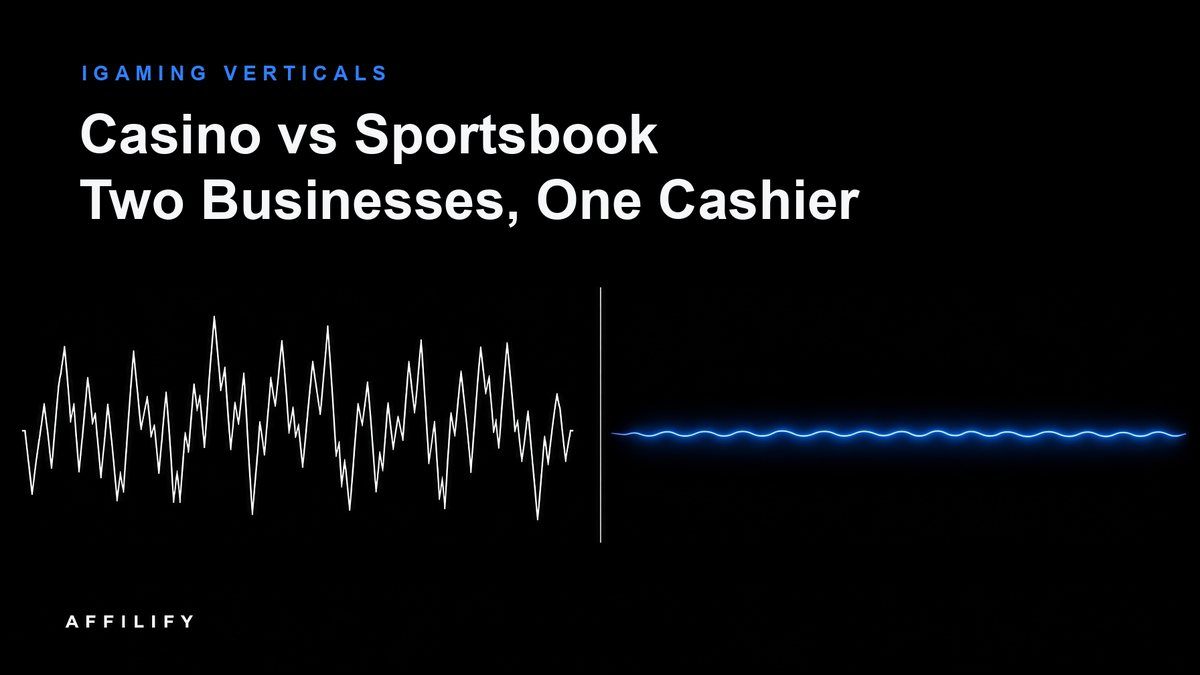
Start with casino unless you already have a sports audience, and check that your target market permits online casino before you commit to it. Sportsbook seasonality is published a year in advance and includes weeks with nothing to sell, while casino pages compound quietly and slowly. Before you sign either one, ask whether your commission is calculated on the account or on the product.
An affiliate with a football tips channel takes a casino deal in July, because the season is over and the money stopped. Three months later the clicks look fine and the revenue is a third of what the spreadsheet promised. Nothing was mis-sold. The playbook just did not travel.
Casino and sportsbook run in the same back office, usually on the same brand, often under the same operator licence, though plenty of markets license the two separately. From the operator's side they nearly are one industry. From the traffic side they share a cashier and not much else.
A sports bet has a deadline
A slot spin does not, and almost everything below falls out of that.
Sportsbook traffic arrives around an event. Kickoff is at 17:30 on Saturday, and interest in that fixture builds across the week, spikes in the two hours before it starts and is worth nothing at full time. Search volume for a match name does not decay. It falls off a cliff.
So your window is measured in hours, and the deposit is anchored to a bet the player already has in mind. Twenty euros on the draw. They are not opening an account, they are placing a bet and an account is the toll.
Casino traffic arrives around a mood and a moment. It is 23:40 on a Tuesday and somebody is on the sofa. Nothing expires at midnight. The query "best payout slots" gets asked in roughly the same volume in February and in August, and the page that answers it is still working fourteen months later.
A calendar you can read a year out
Sportsbook seasonality is published. Next season's fixture list exists before this one ends, so you can plan a content calendar against it with more certainty than most things here allow. You can see the holes coming too, which does not help you avoid them. European domestic football runs August to May, so late June and July carry no fixture worth previewing to a football audience, and a channel that shipped four posts a week ends up publishing into silence.
Something is always on, though, and that part gets left out. Tennis runs through the summer, cricket and MLS keep their own calendars, pre-season friendlies start in July, esports never stops. That is what your existing players keep betting on, and why a revenue share tail puts a floor under a month when new-player flow drops to nothing. It will not match May. It will not be zero.
US-facing traffic has a different shape: a short lull the week after the Super Bowl, closed three weeks later when March Madness starts, then a real quiet spell in July between the NBA finals and the NFL preseason. Tournament summers invert the European picture entirely, turning the dead months into the biggest weeks of the cycle, which is why year on year comparisons here are close to meaningless in alternate years.
Casino is nearly flat by comparison, with a mild winter lift and a soft patch in high summer because people are outside. The rhythms that matter are smaller and they repeat: Friday through Sunday evening carries the week, and the nightly peak sits roughly between 20:00 and 01:00 local.
Put a portfolio in one of them and the cashflow shape follows. All sport means two months a year where costs continue and new-player revenue does not. All casino means a duller line, easier to forecast and harder to spike.
Seven rows that cover most of it
Directions of travel, not quotes. Any particular brand will contradict a row somewhere.
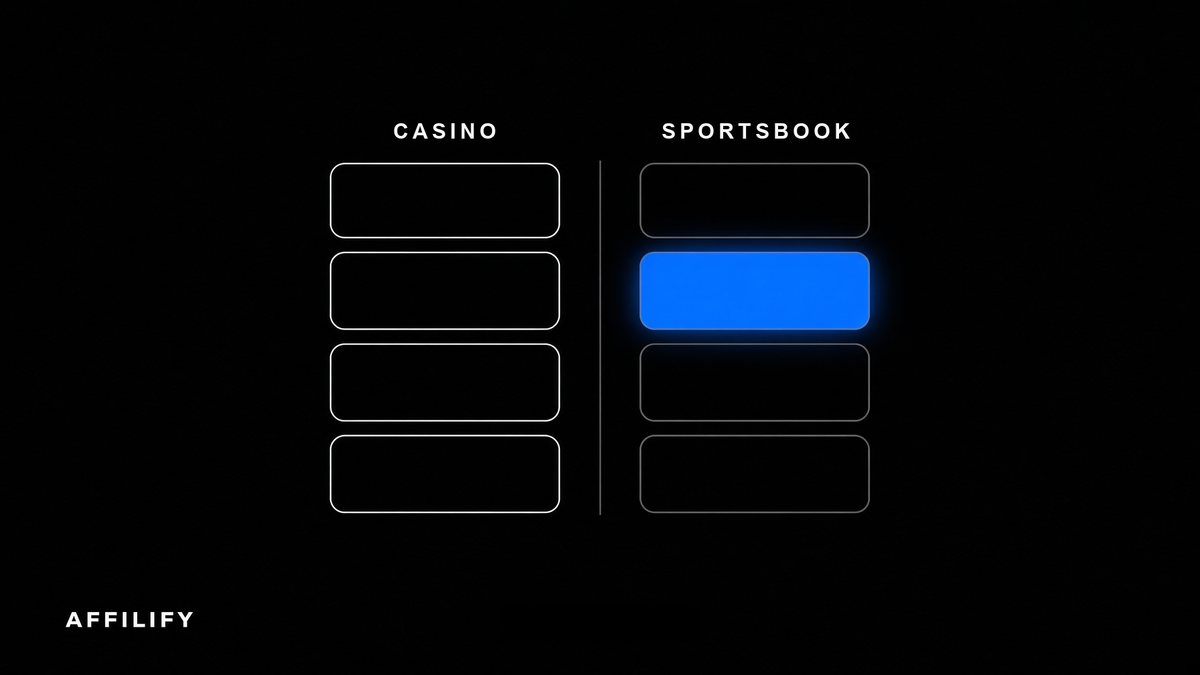
| Dimension | Sportsbook | Casino |
|---|---|---|
| Intent at the source | Event with a deadline, decided before the click | Mood and moment, no expiry |
| Seasonality | Sharp, published a year ahead, with quiet weeks | Close to flat, weekly and nightly rhythms |
| Deposit pattern | Small and frequent, sized to a bet | Larger and less frequent, sized to a session |
| Operator margin | Thin per bet, roughly 5% to 7% of turnover | Fat per deposit, stake recycled all session |
| Player lifetime | Longer, slower churn, tied to a team | Short and spiky, heavy then gone |
| Typical deal in Europe | Lower CPA, tighter qualification, steadier revshare | Higher CPA, GEO sensitive, lumpier revshare |
| Content that works | Timed, recurring, published to a schedule | Evergreen reviews, comparison, search intent |
What an account is worth to the operator
A sports bettor tends to deposit in the tens of euros, several times a month, and stake it across a weekend. The book keeps a thin slice of the money that moves: on mainstream football markets the theoretical hold sits around 5% to 7% of turnover, and what gets realised swings with results. The operator is buying duration. Sports accounts churn more slowly than casino ones, and one tied to a club somebody supports has a reason to stay open.
A casino player deposits less often and larger, commonly several times the sports figure, and a session eats it. The house edge on one spin is a few percent of that spin's stake, but the same money gets staked dozens of times in an evening, so the operator keeps far more of the deposit than the per-spin number suggests. The lifetime runs the other way: heavy for a few weeks, then nothing.
Say that as NGR, because NGR is what a percentage deal is calculated on. Sportsbook NGR per player is small and steady, and it keeps arriving. Casino NGR per player is large, it swings, and then it stops.
There is a heuristic in that, worth holding loosely rather than as a law. A long thin annuity suits revenue share, and that is the sportsbook player. A short fat burst suits CPA, and that is the casino player, who carries the higher CPA across most of Europe. But casino revenue share at 25% to 45% is the industry's standard product, not an odd choice. It pays far more per player and carries far more variance: a different trade, not an unnatural one. The model comparison has the arithmetic.
The offer reflects all of it
Three weeks into a first sportsbook deal, an affiliate who has only run casino opens a support ticket. Deposits are landing and conversions are not. Nothing is broken.
In European football-led markets, sportsbook CPAs typically sit below casino CPAs at the same brand, and they qualify harder. A common sports qualification is a deposit plus a settled bet of at least 10 euros at minimum odds of 1.50, and the word doing the work is settled. The deposit is real on Thursday. The conversion is not, because the bet has not settled, so a Thursday deposit on a Sunday fixture becomes a conversion on Sunday night. That lag looks exactly like broken tracking to somebody who has never seen it. Do not carry the rate comparison outside Europe: US sportsbook CPAs have been among the highest paid anywhere.
Casino CPAs vary far more by country, because a casino account is worth wildly different amounts in a capped licensed market and an unregulated one. Same brand, same month, a spread of three or four times between two GEOs is ordinary.
Revenue share is where the difference gets expensive. Sports revenue share is flatter, thin margin spread over many months, rarely dramatic in either direction. Casino revenue share is lumpier both ways, and lumpiness stops being neutral once negative carryover is in the contract. One player landing a large win, or a month where bonus costs land heavily, can push your NGR line under zero, and that hole is deducted before you earn a cent the following month. The average can look healthy while the variance eats a quarter. How carryover works is worth reading before you sign a percentage on casino traffic.
What you actually have to publish
Casino rewards patience. Reviews, comparison pages, payment method guides, an honest explainer on wagering requirements: none of it expires, and the same page earns in November for a query somebody asked in March. It compounds, and it starts slowly enough that plenty of people quit before month six. You are building a language and market asset rather than a schedule, so which GEO you pick matters more here than in sport.
Sport runs on tempo instead. A preview published at 09:00 for a 15:00 kickoff is worth something for six hours and nothing afterwards, so the formats that work recur by design: the weekly accumulator, the fixture hub rebuilt every August, the offer page tied to one event. Stop for three weeks and you are at zero. There is no back catalogue working while you sleep. It is also the vertical where a following beats a domain, which is why so much of it lives on Telegram and YouTube rather than on a site.
One evergreen slice exists in sport: free bet and bookmaker offer pages hold value all year. They are also the most contested keywords in the vertical, held by sites with a decade of history.
The crossover nobody asks about until it costs them
Many brands run both products behind one account, one wallet and one bonus balance, and a meaningful share of sportsbook depositors end up on the casino tab, often late at night while a result runs. Where a market licenses the two separately this often does not apply at all: the operator runs separate apps on separate wallets, and the questions below answer themselves.
Where it does apply, ask before you sign rather than in a support ticket in month four.
- Is my commission calculated on the account or on the product? A sportsbook revenue share counting only sportsbook NGR means that player's slot losses never reach your line. Some brands calculate at account level, some at product level, and plenty of contracts do not say.
- Which vertical's rate does a CPA conversion take, and can it change? If the qualifying event was a 10 euro football bet, that account is normally priced at the sports CPA permanently, even if the player never opens the sportsbook again.
Bonus costs are the third question and the easiest to overlook: a sportsbook free bet charged against a shared account can land inside the NGR line your casino percentage is calculated on.
None of this is an attribution problem. The click is attributed once and stays attributed, with layered fallbacks for the messy cases. It is a pricing question, and pricing questions get answered by the terms.
On AFFILIFY the commission basis sits in the deal you read before you promote, so account-level or product-level is something you check rather than assume. The honest limit: which one applies is the advertiser's decision, not ours. We can put the question to them and write the answer into the deal. We cannot make a product-level brand pay at account level.
So where do you start
Casino, unless you already have a sports audience, and only where your target market permits online casino at all. That second half is not a formality: sports betting is legal across most US states while online casino is live in a handful, and the accepted GEO list on the offer is where you check.
The reasons are practical. No dead weeks. Evergreen pages compound, so effort from month two is still earning in month ten. The CPA per conversion is higher, so low volume still teaches you something. And the tempo is survivable while you are still learning to read an offer, which is the harder skill in your first month.
Sport asks for other things: speed, a publishing habit and an audience that already turns up when you post. If you have one, ignore all of the above and start where the people are. Without it, sport asks you to build a following and learn a vertical at once, with the evergreen keywords already spoken for.
Starting in casino locks you out of nothing. It just means the first deal you sign is one you can read carefully, in a month with nothing on the fixture list.
Frequently asked questions
Can I send casino and sportsbook traffic to the same brand?
Usually yes, and at many brands it is the same account and the same wallet behind both products. Where a market licenses the two separately, the operator often runs them as separate apps on separate wallets, and you may be dealing with two deals rather than one. Either way, what matters is how the agreement prices each product. Some carry separate rates per product, some carry a single rate applied to whatever the account produces, and some are written only for the vertical the affiliate manager assumed you ran. Get it stated before you start, because a casino landing page under a sportsbook-only deal is not a tracking problem, it is a pricing gap you notice on a statement.
Why is the sportsbook CPA lower than the casino CPA at European brands?
Because a sports account there is worth less per month and more months. The book keeps a thin slice of turnover, somewhere around 5% to 7% on mainstream football markets, so monthly revenue per player stays small even when the player is active every weekend. Casino margin per deposit is far fatter and arrives sooner, which supports a bigger one-off payment. The sports qualification is usually stricter too, requiring a settled bet at minimum odds rather than a deposit alone, so the conversion is confirmed later and more of them never qualify. This is a European pattern rather than a universal one. US sportsbook CPAs have been among the highest in the industry, so do not carry the comparison across the Atlantic.
Does sportsbook traffic really go dead in the summer?
Your publishing goes quiet, your existing players do not. In a non-tournament year European domestic football stops in late May and restarts in August, so late June and July have no fixture worth previewing to a football audience and no offers tied to one. Tennis, cricket, MLS, pre-season friendlies and esports all keep running, which is what a revenue share tail feeds on while your new-player flow drops. US-facing traffic has its own quiet spell in July, between the NBA finals and the NFL preseason. Tournament summers reverse the whole thing and become the strongest weeks of the cycle. The practical answer is not to fight it: hold revenue share players, or hold something evergreen alongside the sport.
Which vertical suits revenue share better?
Sportsbook fits the shape of a percentage more neatly, because long lifetimes and thin steady margin move the month-to-month line less. Treat that as a heuristic, not a rule. Casino revenue share at 25% to 45% is the industry's standard product and pays far more per player, with far more variance, and negative carryover makes that variance expensive: one heavy win or one heavy bonus month drops the line below zero, and the shortfall is deducted before your next month starts earning. So read the carryover clause on any casino percentage before you read the headline rate. It decides more of the outcome.
More from this cluster
Slots vs Live Casino vs Tables: What Converts
A slots player, a live-dealer player and a tables player do not arrive the same way, stay the same way, or pay you the same way. How the three products differ by GEO, by device, and in the deal you should take.
The State of iGaming Affiliate Acquisition in 2026
The player who deposits is the same player. The path that produced the FTD is not. A map of where first-time deposits actually come from now, which channels quietly closed, and what that does to the way you pick a GEO, a brand and a deal.

Welcome Bonus Math: The Bonus and Your Commission Come Out of the Same Pot
Affiliates promote bonuses all day and almost never price one. Here is the arithmetic: what 35x means in euros, what a max cashout does to a player you were counting on, and why the biggest number on the page is usually the worst deal on both sides.