Welcome Bonus Math: The Bonus and Your Commission Come Out of the Same Pot
Affiliates promote bonuses all day and almost never price one. Here is the arithmetic: what 35x means in euros, what a max cashout does to a player you were counting on, and why the biggest number on the page is usually the worst deal on both sides.
A welcome bonus is acquisition spend, drawn on the same budget line that funds your CPA. The number on the banner tells you almost nothing; the wagering multiplier, the stickiness and the max cashout tell you whether that deposit ever turns into revenue you get paid on. Do the arithmetic once and a lot of otherwise baffling deal behaviour starts making sense.
Ask an affiliate what the welcome offer is on their best-converting brand and they answer in under a second. Ask what 35x means in euros and the room goes quiet.
That is not a criticism, it is a gap in the job description. Nothing forces you to price a bonus. You put the number on the page, it converts, the FTD lands, and the arithmetic happens where you cannot see it. Then a deal gets repriced, a RevShare month comes back at a fraction of what the FTD count promised, and none of it looks connected.
It is all connected.
The permitted cost per depositing player
Somewhere in the operator's finance model sits a permitted cost per new depositing player. Every channel draws on it: media spend, your commission, the platform fee, payment processing, and the bonus liability the player walks in holding.
That last one is real money, not marketing air. Bonus cost comes off gross gaming revenue before anybody calculates net, which is why it lands in your RevShare whether or not you were thinking about it. When it lands is set per contract and it changes the whole calculation: some agreements deduct the bonus as granted, the moment it is credited, and some deduct it only once it clears. Confirm which one you are under before anything else here is useful to you.
So when a brand advertises a 200% match up to 500 EUR and a 300 EUR CPA in the same email, one of those numbers is under pressure. Either the bonus is engineered so almost nobody clears it, and on a cleared-only deduction the liability stays largely notional, or the bonus really is generous and the CPA is what moves first. Usually the former. Occasionally the latter, and you find out in month four when your rate steps down a band.
Neither case makes anyone a villain. It makes the two numbers a system.
35x, converted into euros
Take a shape you will meet constantly in Europe: 100% match up to 100 EUR, 35x wagering.
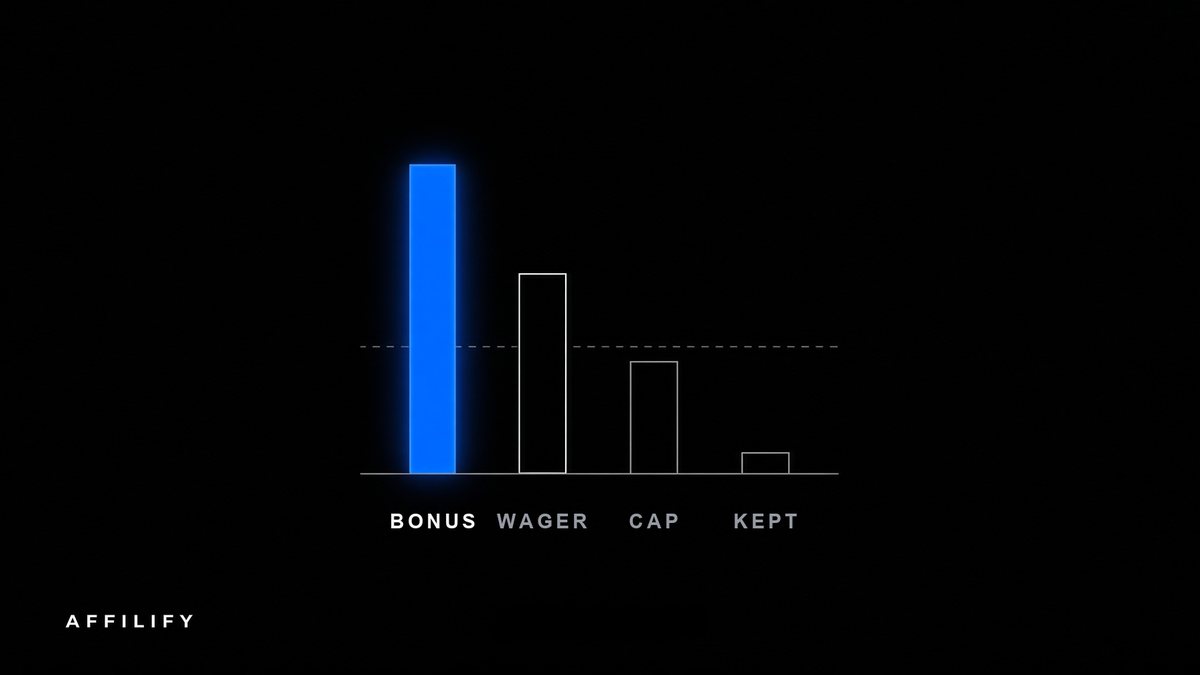
Player deposits 100 EUR, receives 100 EUR of bonus. The 35x applies to the bonus, so the requirement is 3,500 EUR of turnover before anything can be withdrawn. Read that clause carefully: a meaningful minority of brands apply the multiplier to deposit plus bonus. Same 35x, 7,000 EUR of turnover, one word of difference.
Now put a house edge on it. A typical online slot runs around 96% RTP, so roughly 4 EUR of every 100 staked stays with the operator. Against 3,500 EUR of turnover that is about 140 EUR of expected loss.
The player started with 200 EUR of playable balance. Expected balance at the moment the requirement is met: 60 EUR.
So a player who does everything the bonus asks finishes 40 EUR down on their own money, while the operator books 140 EUR of gross gaming revenue, of which 100 EUR was its own bonus money. Take the bonus off and 40 EUR is left. Payment processing and gaming tax come off that too, so NGR on this player lands around 32 to 36 EUR in month one. At a 40% share, your side is 13 to 14 EUR.
Three thousand five hundred euros of turnover. Fourteen euros of commission. That gap is the most useful thing in this article.
Expectation is not destiny. Most players bust before clearing, a few clear and withdraw, one wins properly. Across a few hundred, the 4% grinds toward that number anyway.
Sticky, non-sticky, and which deposits become revenue
This decides more of your RevShare than the multiplier does, and most bonus pages never name it.
A non-sticky bonus keeps the player's own cash separate. Real money is played first, the bonus activates only once the cash balance is gone, and until then the player can withdraw their own 100 EUR whenever they like, forfeiting the bonus.
A sticky bonus welds the balances together. Nothing is withdrawable, not the deposit, not the winnings, until the requirement is cleared. The player's 100 EUR is locked behind 3,500 EUR of turnover.
For the operator, sticky guarantees turnover, because there is no other exit. For you it front-loads the GGR and shortens the relationship: a player who feels trapped rarely deposits twice.
Non-sticky gives you a smaller first month and more of them. A player who tested the withdrawal button early and found it worked is the one still on your statement in month six.
If you run RevShare and you have a choice of brands, ask about this before you ask about the rate.
Max cashout, the cap that ends the relationship
A max cashout caps what a player may withdraw from bonus winnings, whatever they won. Usually a multiple of the bonus: 5x is common, 3x is tight, and a flat 100 EUR ceiling on a 300 EUR bonus is the kind of term that produces forum threads.
Picture it. Player deposits 150 EUR, takes the 300 EUR bonus, grinds out the requirement over three weeks, finishes with 900 EUR on screen, requests a withdrawal, receives 100 EUR. The operator keeps the 150 EUR deposit and voids 800 EUR of winnings under a clause on page two.
Whether or not they read that clause, the account is finished. That is the last deposit that player makes with the brand, and possibly with any brand you send them to, because the sequence they experienced was: your page, this brand, robbed. Your CPA paid in full. Your RevShare on that player, from that afternoon, is a row of zeros.
Max cashout is not fraud, and it should be in the bonus terms. Find it yourself before you promote the offer, and note where it was, because a cap that lives three clicks deep is telling you something.
Three offers, priced the same way
Same 4% house edge, same arithmetic, three structures you will meet on a comparison page.
| Offer | Real cost to clear | What the player likely keeps | What it does to your commission |
|---|---|---|---|
| 100% up to 100 EUR, 35x, no cap | 3,500 EUR of turnover, about 140 EUR of expected loss | About 60 EUR of the 200 EUR balance | Roughly 32 to 36 EUR of month-one NGR, so 13 to 14 EUR at a 40% share; player usually still there in month three |
| 200% up to 300 EUR, 45x, 100 EUR max cashout | 13,500 EUR of turnover required; the 450 EUR balance is expected to be gone at roughly 11,250 EUR of it | Almost always nothing: the balance goes before the requirement does | CPA pays in full, but the operator nets at most the 150 EUR deposit, so the RevShare tail is one thin month |
| 100% up to 50 EUR, 25x, non-sticky, no cap | 1,250 EUR of turnover, about 50 EUR of expected loss | Their own 50 EUR stays withdrawable until they play it | Smallest first month, longest tail, and the deal survives the annual review |
The middle row is the one affiliates fight to rank for. It has the biggest number, the best click-through, and the worst economics on both sides of the table.
Bonus abuse, and why it lands on your side of the ledger
Some players deposit specifically to extract the bonus and leave. Minimum stake, lowest variance the terms allow, clear what can be cleared, withdraw, gone. Most operators price for this.
Here is why it is your problem too. That player made a real first deposit. It met the minimum, used an accepted method, landed inside the attribution window. It qualifies as an FTD on a loose FTD definition, which is what most programs started with, so your CPA pays. Meanwhile the bonus cost comes off gross gaming revenue and the player's own gross is close to nothing, so their NGR contribution is negative. A handful of them pull an otherwise decent RevShare month below zero, and if your terms carry negative carryover, the hole rolls forward. What negative carryover does over a quarter is worth reading before you agree to any percentage.
The tightening you meet in today's terms is the answer to exactly that. Excluded payment methods, because certain wallets and crypto rails concentrate the behaviour. Max bet limits while a bonus is active. Game weighting, where table games count 10% toward the requirement and some titles count zero. Minimum deposit thresholds. CPA qualification criteria. Hold periods, because the pattern only shows after the wagering is done.
Now read that list again as clauses that cost you money, because it is the same list. The hold exists because a deposit is not final for weeks. The qualification rules that shrink your FTD count exist because somebody learned what an unqualified FTD costs. The operator is not being difficult, they are pricing behaviour that is genuinely happening.
AFFILIFY carries some of the same terms, and pretending otherwise would be dishonest. Earnings sit pending and clear on a monthly cycle rather than instantly, commission can be reversed after clearing if the deposit underneath it comes back, and traffic quality is reviewed continuously rather than once at signup. Every reversal appears as a line item naming the conversion, and the whole pipeline is written down.
The smaller bonus is often the better business
Follow the three rows forward twelve months and the ranking inverts.
The 200% offer wins the click. It also selects for players who came for the bonus rather than the product: short half-life, bad NGR profile. Your CPA clears, your RevShare never develops, and the deal itself is unstable, because the brand is losing money on the cohort you send. Deals like that get repriced or pulled, and the affiliate finds out by email.
The 100% up to 50 EUR offer wins fewer clicks and more players. Lower expectations, cleared requirements, an early successful withdrawal, a relationship that outlives month one. Nothing dramatic. It is just where the commission is.
One second-order effect. If your traffic keeps producing the profile smaller offers attract, you have a better case to make in rate conversations, because your account looks like what the operator wants to buy.
What to ask before you build a page around a bonus
Send this to the affiliate manager. Ten minutes of their time, one quarter of yours.
- Is the bonus deducted from NGR as granted or only once cleared, and does bonus turnover count toward gross before that deduction?
- Does a deposit made with the bonus code still qualify as an FTD, or is there a separate minimum for bonus deposits?
- Sticky or non-sticky, and is the multiplier on bonus only or deposit plus bonus?
- Is there a max cashout, and what is it as a euro figure rather than a multiple?
- Which payment methods are excluded from the bonus, and which of those also fail FTD qualification?
- What happens to my commission if a player is flagged for bonus abuse: reversed, held, or paid?
- How long can that reversal happen after the commission has cleared?
- Game weighting: which categories count less than 100% toward the requirement?
Question six separates a program that has thought about this from one that will improvise at your expense. Question seven is the one people forget, and then meet in a quarter they thought was closed. If the answers arrive as adjectives rather than numbers, read the rest of the offer sheet with the same suspicion. The vagueness will not stop at the bonus section.
One more check while you are asking. The payment methods excluded from a bonus are often the most popular ones in the market you are targeting, so the offer on your page is unavailable to a large share of the people reading it. How payment methods move FTD conversion covers that gap, and it is a common reason a bonus page converts clicks but not deposits.
The bonus is not your product. It is the operator's marketing budget, written as a number that looks like a benefit, drawn on the same account as your commission. Once you can price one, you can tell a generous brand from a loud one in about ninety seconds.
Frequently asked questions
What does 35x wagering actually mean in money?
It means the bonus has to be turned over 35 times before anything can be withdrawn, so a 100 EUR bonus carries 3,500 EUR of required stakes. The clause worth checking sits right next to the number: some brands apply the multiplier to the bonus alone, others to deposit plus bonus, and the second version doubles the work behind the same advertised 35x. Ask which one applies before you put the offer on a page.
Does the welcome bonus reduce my RevShare?
In almost every deal, yes. Bonus cost is one of the standard deductions taken off gross gaming revenue before NGR is calculated, alongside payment processing and gaming tax. That is why a heavily bonused player can generate a large gross figure and still produce very little net in month one. Ask for the deduction list in writing, ask in what order it applies, and ask whether the bonus is deducted when it is granted or only once it clears.
If a player is flagged for bonus abuse, do I lose the commission?
Often, and it varies by program, so get the answer before you promote rather than after. Some brands void the conversion outright, some hold it pending investigation, some pay it and tighten qualification going forward. The related question people forget is how long a reversal can happen after the commission has already cleared. Ours can be reversed if the deposit underneath it comes back, and every reversal appears as a line item naming the conversion.
Is a bigger welcome bonus better for conversion?
It converts more clicks and worse players. A 200% match with a 45x requirement and a max cashout selects for people who came for the bonus rather than the brand, which means a short lifespan and a weak NGR profile. A smaller offer with a lower multiplier and no cashout cap wins fewer clicks, keeps more of them, and sits on a deal the operator can actually afford to leave in place.
More from this cluster
Casino vs Sportsbook Traffic: Two Businesses That Share a Cashier
Same brand, same back office, two completely different businesses to send traffic to. Seasonality you can read a year out, deposits sized differently, deal shapes that do not transfer, and the pricing question almost nobody asks before signing.
How to Read an iGaming Offer, Line by Line, Before You Agree to It
Someone sends you a PDF with one enormous number on it. Here is the same sheet read in the order that actually decides what you get paid: GEO grid, qualification, hold, baseline, caps, sources. The rate goes last, and the nine questions you send back go first.