Payment Methods and FTD Conversion: The Cashier Decides More Than the Bonus Does
An affiliate optimises the page and the bonus, then loses the player on a deposit screen they have never seen. Pix, UPI, BLIK, iDEAL, card declines, wallet bonus exclusions and crypto: how the method list decides your registration-to-FTD rate, and the twenty minute check that catches it before you build.
Your page and your bonus copy get the click. The cashier decides whether it becomes a first deposit, and in markets running on instant local rails a brand without Pix, UPI, BLIK or iDEAL loses players who already had their banking app open. Check the method list yourself, in the GEO you are targeting, before you build anything on the offer.
A player in São Paulo reads your review page, likes the 100% match, clicks through, registers, opens the cashier and sees Visa, Mastercard, Skrill. No Pix. He closes the tab.
You got a registration. You did not get an FTD. And on the report, that looks exactly like bad traffic.
The gap between registration and FTD is usually a payments problem
Affiliates spend their optimisation budget on the two screens they can see: their own page and the brand's landing page. Headline, proof, button placement, page speed. All reasonable. All upstream of the step where money moves or does not.
The cashier sits behind the login wall. On almost every brand it renders only after registration, so the surface that decides your CPA is the one nobody audits before promoting.
The cost has a specific shape. Under a CPA deal, a registration that never deposits pays you nothing while the operator keeps the account, the contact and a player it can retarget for months. Do that at volume in a market the cashier does not serve, and your affiliate manager reads the same numbers and reaches a different conclusion: your traffic is weak.
Other deal shapes feel it differently, and one barely feels it. CPL and CPR pay on the registration itself, so a stalled cashier costs you the player's future value but not the commission. RevShare and hybrid take the damage through NGR instead, since bonus cost and payment processing are standard deductions and reversals land there too. Which model you are on decides whether a bad cashier is a conversion problem or a margin one.
Registrations and FTDs are separate events in your statistics, with the GEO attached, so the gap between them is something to look at rather than guess about. If the same traffic in the same country behaves differently across two brands, the creative is not where to start.
Every hop is somewhere to lose the player
Time to FTD is the metric almost nobody tracks, and the one that explains most of the drop.
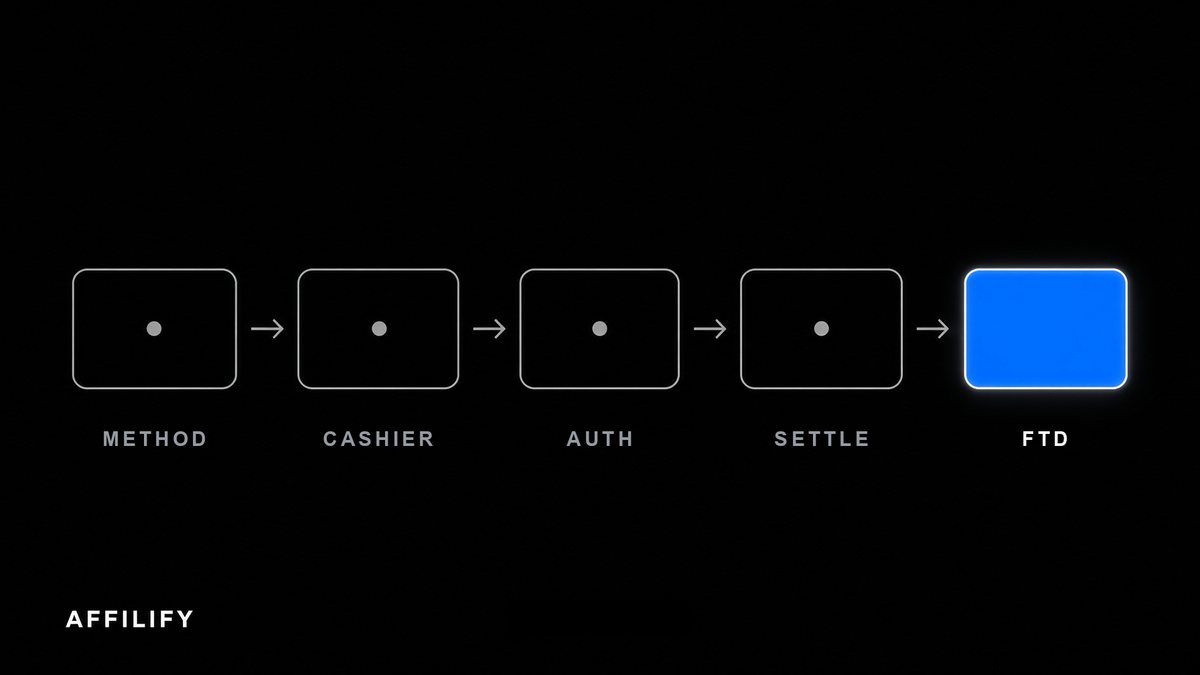
Count the steps in a good deposit. Pick method, type amount, approve in the banking app with a thumbprint. Three actions, about eight seconds, and the money lands while the page is still on screen.
Now the bad one. Pick method, type card number, expiry, CVV, submit, get redirected to a bank page in a different visual language, wait for an SMS code, switch to the messages app, come back to a session that may not be alive, paste the code, wait, land on a page saying the transaction is being processed.
Same player, same intent, same bonus. The second flow leaks at every hop, worst on mobile, where every redirect and app switch is a chance the browser tab gets buried and never comes back. And the last screen is ambiguous, so the player cannot tell whether it worked. A few come back to check. Most do not.
Local instant rails, and why they reset the floor
Several large markets moved off cards onto bank-to-bank instant rails: local, nearly free, settling in seconds, no card network and no 3D Secure anywhere. Plenty of offer sheets have not caught up.
Pix in Brazil is a central bank rail. A QR code or a key (a phone number, an email, a tax ID), scanned in the banking app, settled in seconds. It is less a payment option than the way money moves.
UPI in India works app to app against a virtual address, no card details anywhere. BLIK in Poland issues a six digit code from the banking app, valid about two minutes, confirmed with a tap in that same app. iDEAL in the Netherlands is a bank redirect Dutch users have been completing for years.
A cashier without the local rail asks those players to use a habit they do not have. The bonus does not fix it. A 200% match on a deposit nobody can conveniently make is a number on a page.
One caveat, because rail and licence are entangled. These are domestic banking systems, so whether a brand carries the local rail and whether it has real standing there tend to be the same question asked twice. All four have moved recently and none of it is settled: licensing, tax treatment and whether real-money play is permitted at all are open questions, and casino and sports betting often get different answers under one flag. Check the current position, and the brand's permitted-markets list, first.
Cards fail more often than anyone tells you
The decline is not the operator's payment provider being bad at its job. It is the issuing bank, applying rules to a merchant category it treats as high risk.
Open the same cashier twice with two different cards and you will see it. Declines here are routine in a way they are not in ordinary e-commerce, and the reason sits upstream of anything the brand can change.
Several things stack:
- The gambling merchant category is flagged. Some banks block it outright, and many more offer a gambling block toggle that a past version of the player switched on and forgot about.
- Some jurisdictions restrict cards for gambling by law. Britain's regulator banned credit cards for gambling in 2020, and comparable rules exist elsewhere, so check your market rather than assuming either way.
- Cross-border. A card issued in one country, a merchant registered in another, first transaction, unfamiliar amount.
- Strong customer authentication adds a 3D Secure step-up, which is a security feature and also a hop, and hops cost you players even when they succeed, because the redirect out and the wait for a code both land on a phone where the tab is one notification from gone.
What matters commercially is what the player sees: a generic message, no reason, no next step. They do not conclude that their issuer blocks a merchant category. They conclude the site is broken and leave. Which is how genuine, well-targeted traffic produces a poor FTD count in a market where cards fail most.
Wallets and vouchers, and the promise your page made
Plenty of players want no gambling line on their bank statement, and two product categories exist to serve them.
Skrill and Neteller are the long-standing pair: fast, familiar, a layer between the bank and the brand. paysafecard is a different logic entirely, cash bought at a kiosk, a 16 digit PIN, no bank involved and a hard ceiling on what can be lost.
Then the catch, common enough that you should assume it until told otherwise. Many brands exclude wallet deposits, and often vouchers, from bonus eligibility. The player takes the fastest route, deposits successfully, and the welcome bonus your page promised does not appear. That is your credibility, not the brand's.
paysafecard carries a second problem. Withdrawals almost never go back to it, so at cashout the player is asked for the exact bank method he was avoiding.
There is a third clause, separate from bonus terms and easy to miss. Some deals exclude certain methods from CPA qualification. A deposit can be entirely real, sit in the operator's account, and still not count as your qualifying FTD. Get that in writing before you promote, alongside the minimum amount and the qualification window. Reading an offer line by line covers the rest of that clause set.
Crypto is fast, and it tells you what kind of brand you are looking at
Crypto solves the decline problem by removing the party doing the declining. No issuer, no merchant category, no 3D Secure. BTC, LTC and increasingly USDT, confirmed in minutes, working where cards will not.
The player is different, which matters before you build for them. Crypto depositors self-select: comfortable with wallets and confirmations, moved by rakeback, reload and VIP mechanics rather than a headline match. A page that ranks brands by welcome offer aims at a motivation they do not have.
It is also a licensing signal. You will rarely see crypto under the stricter European licences, so a crypto-forward deposit list usually points to an offshore one. Not automatically a bad partner, plenty of affiliates run them profitably, but it changes who you can legally market to, and what happens if a market you rely on regulates.
The method families, side by side
Speeds below describe the flow the player experiences, not back office settlement.
| Method family | Typical speed | Where it matters | What usually goes wrong |
|---|---|---|---|
| Instant bank rails (Pix, UPI, BLIK, iDEAL) | Seconds | BR and NL, plus IN and PL where the licence permits | Absent from the cashier, because the brand has no local banking standing |
| Cards (Visa, Mastercard) | Seconds when approved | Most of Europe, CA, tier 1 | Issuer declines on merchant category or cross-border risk, plus a 3D Secure hop |
| Open banking and bank transfer | Minutes to a day | DE, SE, FI, NL | Redirect, login, confirm; funds arrive after the player stopped watching |
| E-wallets (Skrill, Neteller, MuchBetter) | Seconds | Grey markets, privacy-minded players | Bonus-excluded at many brands, sometimes excluded from CPA qualification |
| Prepaid vouchers (paysafecard) | Seconds | AT, DE, cash-preferring players | Withdrawals almost never return to it, low ceilings, often bonus-excluded |
| Crypto (BTC, LTC, USDT) | Minutes | Offshore-licensed brands | Wrong chain, confirmation waits, and usually no bonus |
| Cash at counter (OXXO, boleto) | Hours to days | MX, BR and wider LatAm | The player leaves the site to pay, and many never come back |
Those country codes mark where a method is the local habit, not where you are cleared to promote: that is the licensing question from two sections up, answered brand by brand. Either way the column asks the real question. Not how many methods a brand carries, but whether it carries the two this country uses.
What to do about it, in twenty minutes per brand
None of this needs tooling. It needs somebody to open the cashier.
- Register a real account with your target country selected. The country is locked at signup and the cashier is built from it. Pick the wrong one and you are looking at a cashier your players never see.
- Do it on a phone, VPN off or set correctly, language set to the market. Most of your traffic is mobile, the app-switch hops only exist there, and a cashier rendered for the wrong region carries different methods and minimums.
- Write down the method list, the minimum per method, and the currency. A $20 minimum where people deposit the equivalent of five is a filter you are paying to send traffic through.
- Open the bonus terms and find the excluded methods line. It is usually one line.
- Email the affiliate manager two separate questions: which methods are excluded from bonus eligibility, and which from CPA qualification. Those answers differ more often than you expect.
Do this in the same pass as your tracking link QA. You are already registering a test account and walking the funnel, and the cashier is two clicks further on. While you are in the bonus terms, run the match math against the eligible methods, not the banner.
Where AFFILIFY sits deserves a straight answer. We do not operate anyone's cashier and cannot add Pix to a brand that never built it. What the platform does is keep registrations and FTDs as distinct events with the GEO attached, and put deal terms in front of you before you send a click. Brand selection is the lever, and it is yours.
One last connection back to your balance. A deposit is not final when it happens, and methods with heavy chargeback exposure produce reversals weeks later, which is part of why holds exist and why commission can leave a balance after it was counted.
The bonus gets attention because it is the number on the banner. The method list gets none because it sits behind a login. One of them is copy. The other is whether the money can physically move.
Frequently asked questions
I get plenty of registrations but very few first deposits. Is that a traffic problem?
Not necessarily, and the cashier is the cheapest thing to rule out first. Register a real account with your target country selected, open the deposit screen on a phone, and look at what is actually offered. If the local instant rail is missing, or the list is card-only in a market where banks block gambling merchants, your traffic can be entirely genuine and still stall at the deposit step. Compare the same traffic across two brands in the same country before you touch the creative.
Should I choose a brand by its CPA rate or by its payment methods?
Rate times conversion is the only number that matters, and the method list is a large part of the conversion half. A $120 CPA at a brand carrying Pix in Brazil can pay more per thousand clicks than a $180 CPA at a brand that does not. Check the cashier first, then compare rates, because a rate you rarely trigger is not income. On RevShare or hybrid the same problem arrives through NGR instead, since bonus cost and payment processing come off the revenue your percentage is calculated on.
Are e-wallet deposits really excluded from welcome bonuses?
At many brands, yes, and paysafecard and crypto are often on the same exclusion line. It is written into the bonus terms rather than the offer sheet, so it is easy to miss. The problem is that your page made the promise: the player deposits with Skrill, gets no bonus, and blames you. Read the excluded methods line before you publish the offer, and say so on the page if it applies.
Does a brand accepting crypto tell me anything useful?
Yes, mostly about licensing. You will rarely see crypto in a cashier under the stricter European licences, so a crypto-forward deposit list usually points to an offshore one. That is not disqualifying, but it changes which markets you can legally promote to and how exposed your site is if one of those markets regulates. Treat it as information about the partner, not just a payment convenience.