How to Read an iGaming Offer, Line by Line, Before You Agree to It
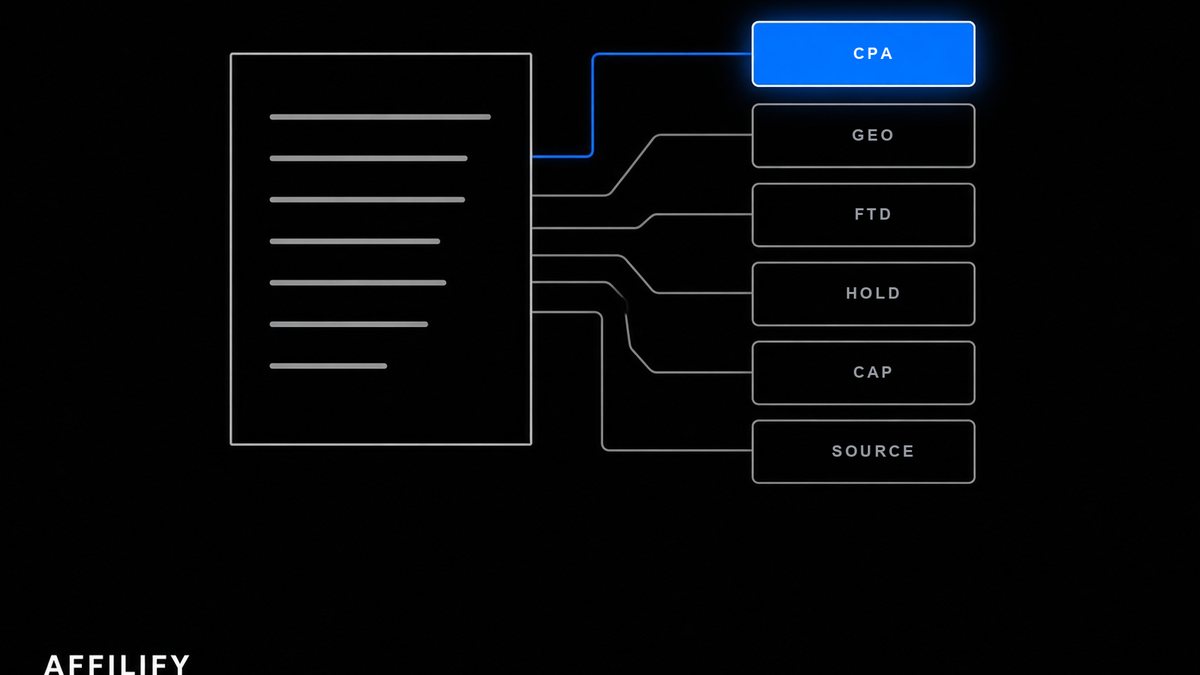
Someone sends you a PDF with one enormous number on it. Here is the same sheet read in the order that actually decides what you get paid: GEO grid, qualification, hold, baseline, caps, sources. The rate goes last, and the nine questions you send back go first.
The headline rate is the least informative number on an offer sheet. What decides your money sits further down: which GEOs actually carry that rate, what a conversion has to do to count, how long the money waits before it clears, and which traffic sources are allowed to produce it. Read those first. Then go back and look at the rate.
Someone sends you a PDF. A logo, one enormous number, a row of flags, and nine lines of grey text under a heading called Terms. You have twenty minutes before you reply, and the number is the only thing on the page you understand.
That is how most affiliates meet their first deal. Below is the same sheet, read in the order that decides what lands in your wallet.
"Up to" is the whole clause
"Up to $250 CPA." Four words, and the one carrying the weight is not the number.
Up to means $250 exists somewhere in the grid: some country, some volume band, some qualifier. It does not mean it exists for you. CPA means a fixed payment per qualifying player, and the word doing the work there is qualifying, which gets defined two pages later in a paragraph you have not reached yet.
A rate is a promise about arithmetic that other clauses perform. Take $250 in a GEO where you have no distribution, gated behind a minimum deposit half your players will not reach, paid after ninety days, capped at forty a month. Set it next to $90 with none of that attached, in a country where you already rank. The second pays more, and neither PDF will say so.
So you compare offers line by line, never by headline. Read the sheet back to front: GEO grid, qualification, hold, baseline, caps, accepted sources. The rate goes last.
The GEO list, and the grid hiding behind it
Most sheets show flags. Flags are decoration. What you need is the matrix: every country code the deal accepts, with a rate against each, for the model you intend to run.
The gap between those two things is where the $250 lives. A realistic CPA grid might pay $250 for NO and FI, $210 for DE, $120 for PT and CA, and $45 for BR and IN. Same offer, one headline. If your audience is Brazilian, the honest number on that page was always $45. Better to know now.
Rates differ by country for reasons that are not arbitrary: what a player there is worth over a year, what the operator's licence permits, whether the payment methods people use are in the cashier, and how many affiliates already fight over the same search results. A high rate often marks a market that is hard, not one that is generous. How to read a geo payout matrix goes through one properly.
Two things the flag row will never tell you. Whether a listed country is one the operator is licensed for or one it merely accepts, a difference that surfaces months later when traffic gets voided and the budget is spent. And whether your GEO appears on the list for the model you want: plenty of grids run CPA in eight countries and RevShare in thirty.
Qualification: a registration is not an FTD, and an FTD is not always paid
This line generates more disputes than the rest of the sheet combined, because two people can use the word FTD for a month and mean different events.
A registration is a person who opened an account. No money moved. Some deals pay on that (CPL, CPR). Most do not.
An FTD is the first real-money deposit that player ever makes with the brand. Straightforward, until the qualifiers arrive. A qualifying FTD usually has to clear some combination of:
- a minimum amount, typically $10 to $25, sometimes quoted in a currency your players do not deposit in
- an accepted payment method, with certain e-wallets and often crypto excluded, because that is where bonus abuse concentrates
- a wagering condition, where the deposit has to be turned over once before it counts at all
- a time window, so a deposit made 45 days after registration is a deposit but not one attributable to your click
- occasionally a survival rule: the player must still be active at day 30
Stack four of those and your dashboard counts 62 while the statement pays 44. Nobody stole anything. You counted deposits, they counted qualifying deposits, and the difference was written down before you started.
Get the exact list in writing, before you promote. If any of the vocabulary is doing unfamiliar work, the FTD, NGR, CPA, CPL and CPR glossary defines each term by what it does to your balance.
The hold, and why it is not a trick
Every honest offer has one. Thirty days is common, sixty is normal, ninety is a lot without being an automatic red flag.
Here is the version managers rarely say plainly. A deposit is not final at the moment it happens. Cards get charged back. Bonus abuse surfaces on a delay, once the operator can see the wagering pattern. Investigations take weeks. The hold is the window where all of that becomes visible, and its job is to stop the brand paying a $250 CPA for a player who reversed the deposit on day eleven.
A program with no hold has not thought about chargebacks, which is worse for you than a long one.
What to ask: how long, counted from which event (the deposit itself, or the close of the month it fell in), and what releases the money. Then ask what can reverse commission after release. That is the clawback window, a different clause, and the one that turns up in a quarter you thought was closed.
Ours is a monthly clearing cycle rather than a per-conversion hold. Earnings accrue as pending and clear to available on the 15th, and anything under an open investigation on that date clears when the investigation resolves rather than when the calendar says. Reversal after clearing is possible, because an underlying deposit can still come back, and when it does the amount leaves the balance with a line item naming the conversion and the reason. The full pipeline.
Baseline and caps: the two lines that quietly redefine the rate
A baseline is a volume floor under the headline rate. "$250 CPA at 15+ FTDs per month" means $250 is conditional, and the sheet may not bother saying what you get at fourteen. Sometimes the rate steps down a band. Sometimes the deal converts to RevShare. Sometimes it ends.
Two questions, and the second is the expensive one. What is the rate below the baseline, and is the step-down applied to the whole month or only to the shortfall? A retroactive baseline turns twelve conversions at $250 into twelve at $150 the second you miss fifteen. That is $1,200 gone from a month you thought had gone fine.
A cap is the ceiling on the other side. "Up to 50 CPA conversions per month" is a real constraint on anything that scales, and the thing to establish is what happens to number 51. Three normal answers: it pays nothing, it rolls into next month's allocation, or that player drops to RevShare. Wildly different outcomes, and the sheet rarely picks one.
Ask too whether the cap is per brand or shared across the operator's group. A group-wide cap is a race, and you would want to know you had entered one.
The accepted source list decides whether your traffic counts at all
Everything above assumes your traffic is permitted. If your channel is unusual, read this section first.
Most sheets carry a short allow list and a long deny list, and the deny list is where accounts die. Incentivized traffic and brand bidding are the two that sit in a permission-per-brand tier rather than an open one: not automatically banned, never safe on silence, and only ever cleared by a written yes that names the source. Pop and clickunder placements, adult inventory, some app-install networks, cashback and coupon sites, and anything resembling a misleading pre-lander sit lower again. Some brands ban whole ad platforms because their licence in that market restricts the format.
What you want in writing is your own channel, named on the allow list, not merely absent from the deny list. Then ask the follow-up nobody asks: what happens to commission already earned through a source that gets disallowed later. Restricted traffic sources works through all three tiers and the approval conversation that keeps you out of the middle one.
If there is a percentage in the offer, extract two more definitions
Two, and each is a longer argument than this section can settle.
The first is what NGR means in this deal specifically: which deductions come off gross gaming revenue, and in what order. Bonuses, payment processing and gaming tax are standard. Administrative fees, platform fees and a share of chargeback losses are negotiable and usually present anyway. Two offers both advertising 40% can pay very different money on identical traffic, and the deduction list is the reason.
The second is negative carryover: whether it applies, whether it is per brand or pooled across the operator's brands, and whether a deficit ever resets. Pooled is the version people misread. A bad month at one brand eats a good month at another, and a deficit that never resets follows you into a quarter where your traffic did nothing wrong.
The sheet, line by line, and the email to send back
| Offer line | What it says | What to actually ask |
|---|---|---|
| Commission | "Up to $250 CPA" | Which countries pay $250, and what mine pay |
| GEO list | "Tier 1 and selected Tier 2" | The full country list with a rate against each code |
| Conversion | "Paid per FTD" | Minimum amount, method, wagering, time window |
| Hold | "Standard hold period" | How many days, from which event, what releases it |
| Reversals | Usually not mentioned | The clawback window and what triggers it |
| Baseline | "Minimum 15 FTDs per month" | The rate at fourteen, and whether it is retroactive |
| Cap | "Up to 50 conversions monthly" | What number 51 becomes, and is the cap group-wide |
| Traffic | "Quality traffic only" | The written allow list, naming my channel |
An offer that answers all eight in specific sentences comes from a partner. One that answers in adjectives (competitive, flexible, industry-standard) has told you how month three will go, and you should believe it the first time.
So send this back before you build anything. Delete what does not apply.
- The full GEO grid: every accepted country code with the CPA and RevShare rate against it.
- The exact definition of a qualifying deposit: minimum amount and currency, accepted payment methods, any wagering requirement, any window between registration and deposit.
- Hold period in days, counted from which event, and what releases it.
- The clawback window, and the reasons commission can be reversed after release.
- Baseline, if there is one: the rate below it, and whether the step-down is retroactive for the month.
- Cap, if there is one: per brand or group-wide, and what happens to the first conversion above it.
- A written allow list for my traffic sources, naming my channel specifically.
- For any percentage: the NGR deduction list, the order it applies in, and whether negative carryover is per brand, pooled, or absent.
- Reporting: conversion-level rows, or monthly totals?
Nine questions. A good affiliate manager answers seven inside ten minutes and goes to ask somebody about two. That is a fine outcome. The bad one is where all nine come back as reassurance.
Our own version of this is deliberately unromantic. Deal terms sit in front of you before you promote, the ladder is published instead of negotiated in the dark, and every commission traces back to a conversion row you can open in your own statistics. There is a hold. There is a gate at Trial. Both are written down, which is the point. An offer sheet exists so you can check it, and a program that makes checking difficult has already answered the only question that matters.
Frequently asked questions
What does "up to $250 CPA" actually mean on an affiliate offer?
It means $250 is the top of a grid, not your rate. It exists for particular countries, usually at a particular volume band, and only for deposits that clear the deal's qualification rules. Ask for the country-by-country grid with a rate against each code, for the model you intend to run. Until then the headline is marketing, not a payout.
Why does the same offer pay different CPA rates in different countries?
Because a player is worth a different amount in each market. Lifetime value, the operator's licence conditions, whether the local payment methods are supported in the cashier, and how much affiliate competition exists all move the number. Useful side effect: the countries a grid leaves out tell you where the brand is not licensed or would rather not receive traffic.
Can an affiliate manager change the terms after I have started sending traffic?
Usually yes, with notice, because most agreements let either side revise rates and source rules going forward. What should not change is the rate on conversions already recorded. Ask which parts are fixed for a term and which are revisable, get the notice period in writing, and keep every version of the deal you agreed to.
If a brand and I disagree on the FTD count, what evidence settles it?
Conversion-level rows on both sides, not monthly totals. You want a timestamp, country and deposit reference behind each counted conversion, so the two lists can be lined up and the gap named. That is why reporting granularity belongs on the question list before you sign: monthly totals leave you nothing to argue with.
More from this cluster
Slots vs Live Casino vs Tables: What Converts
A slots player, a live-dealer player and a tables player do not arrive the same way, stay the same way, or pay you the same way. How the three products differ by GEO, by device, and in the deal you should take.
The State of iGaming Affiliate Acquisition in 2026
The player who deposits is the same player. The path that produced the FTD is not. A map of where first-time deposits actually come from now, which channels quietly closed, and what that does to the way you pick a GEO, a brand and a deal.
Casino vs Sportsbook Traffic: Two Businesses That Share a Cashier
Same brand, same back office, two completely different businesses to send traffic to. Seasonality you can read a year out, deposits sized differently, deal shapes that do not transfer, and the pricing question almost nobody asks before signing.