Restricted Traffic Sources: What Closes an Account, and What Does Not
Three tiers of traffic source: generally accepted, needs written permission per brand, and never. Almost every lost deal happens in the middle tier, where somebody read silence as a yes. Brand bidding and incentivized traffic explained properly, plus what a reversal actually costs.
Traffic sources sort into three tiers: generally accepted, needs written permission per brand, and never. Almost every account loss happens in the middle tier, where somebody read silence as a yes. Brand bidding and incentivized traffic are the two that catch people who genuinely believed they were clean.
Almost nobody who loses a deal set out to cheat. They are usually working hard, convinced they did nothing wrong, and right in a narrow sense that helps them not at all. They ran a source the brand does not accept, it found out, and the conversions came off the statement.
The rules that catch people are rarely the ones they braced for. Nobody is surprised that bot traffic ends an account. Plenty are surprised that buying search ads on the brand's own name does.
Three tiers, and the middle one is where the damage happens
Every operator publishes an allowed-sources list somewhere in its terms. Read enough of them and the same three-tier shape shows up, whatever vocabulary the brand dresses it in.
Tier one, generally accepted. Open by default at almost every brand:
- Organic search and your own content, on a domain you own. Nobody argues about it, which is part of why it is worth the eighteen months it takes to build.
- Paid social, where the brand permits paid media at all, and plenty do not. Where it is open, the brand's creative rules and the platform's gambling policy apply at once: Meta certification for a market does not mean the operator will accept your ad copy.
- Streaming, short video and community channels where the platform permits gambling promotion. Twitch, YouTube and Telegram each hold their own position, and each has moved it.
- Display on sites you own.
Tier one still has rules. It just means the source is not in question, so any argument will be about the creative.
Tier two, permission per brand. The grey stripe down the middle of every terms page. Brand bidding, email, push, bought display and pop inventory, incentivized placements, and anything where you pay a third party per user. These end accounts routinely, nearly always because the affiliate read the absence of a "no" as a "yes".
Tier three, effectively never. Bots and scripts. Self-clicks and self-registrations. Forced or hidden clicks, including clicks fired under a video player. Toolbars that inject a click nobody made. Impersonating the operator's support, trademark abuse in ad copy, adult inventory, anything sitting next to malware.
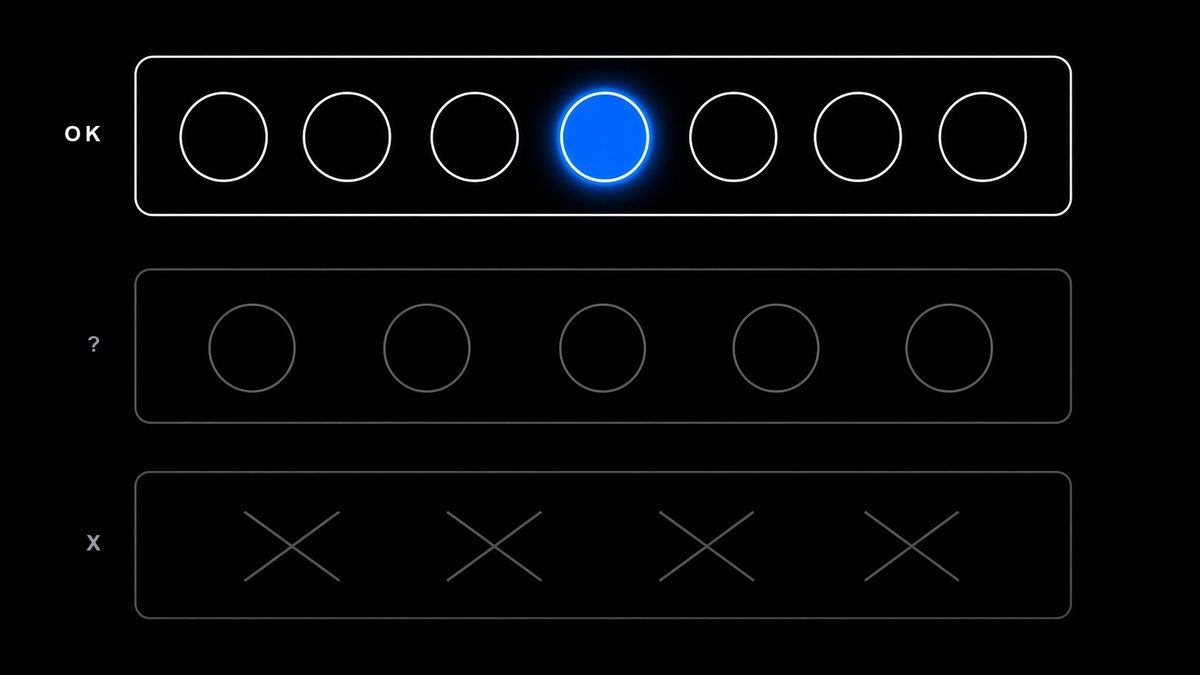
Tier three is short and obvious. Nearly all the real trouble comes out of tier two.
Brand bidding: why it gets refused, not just banned
Say the brand is Casino X. It already buys the search term "casino x" every day, because if it stops, somebody else sits above its own organic result. A player typing that name into Google has already decided. Now you bid on it too, win the auction, and the player deposits through your link.
Look at what that bought. The player was arriving anyway. The operator's own paid search now costs more, because you are in the auction pushing the price up. And it has paid an acquisition fee for a player it already had. Same person, twice the cost, no new revenue. The objection is arithmetic, not morality.
Which is why brand bidding is the most common way to lose a good deal while feeling entirely innocent. Cheap clicks, a cost per FTD of maybe $12 against the $60 your other campaigns run at, because you are buying people who were already sold. Every metric you judge a campaign by says this is your best one. To the operator it reads as an invoice for nothing.
Some brands do allow it under conditions: a negative keyword list, no brand name in the headline or display URL, or an exclusive arrangement with one partner paid to defend the term. Specific, written down, per brand.
What is never enough: the terms do not mention brand bidding, so you assumed it was fine. Absence of a prohibition is not permission. Silence defaults to no, because the operator wrote down what it wanted to buy. Reading an offer properly is mostly the skill of noticing what a document does not say.
Incentivized traffic, and the NGR that arrives three months late
"Sign up through my link and get 5 EUR" produces beautiful numbers for about a fortnight.
Registrations climb. FTDs land. Your cost per acquisition looks like something to scale on Monday. Then open the same cohort in month three: redeposits near zero, NGR near zero, accounts nobody opened again once the reward cleared.
The mechanism is working as designed. You paid people to perform the action that triggers your commission, so you selected for people motivated by your payment rather than the product.
Which consequence bites depends on your model. Under CPA the operator absorbs it, which is why CPA deals carry the tightest incentivized-traffic clauses, the longest holds before money clears, and survival rules that need the player still active at day 30. Under RevShare you absorb it, because bonus money comes off inside NGR, and a batch of reward-seekers can hold your revenue share near zero for a month while the FTD count looks healthy.
Either way the evidence arrives late. The FTD looked fine in week one. The NGR curve tells the truth in month three, by which point you have scaled the source and spent the budget. Operators watch that curve, and for longer than you do.
Some brands do run approved incentivized campaigns, at a reduced CPA that prices the retention profile in from the start. A €90 rate agreed up front beats a €250 rate reversed in March.
Where each source sits
| Source | Typical status | What makes it acceptable | What gets it refused |
|---|---|---|---|
| SEO and owned content | Accepted | Own domain, accurate bonus terms, 18+ | Misstated terms, scraped content, cloaking |
| Paid social | Accepted where the brand runs paid media | GEO certification, approved creative | Cloaking, targeting under the age limit |
| Permission needed | Your own opt-in list, working unsubscribe | Rented lists, the operator's name in the from field | |
| Push notifications | Permission needed | Subscribers you collected, clear opt-out | Bought lists, alerts faked as system messages |
| Brand bidding | Permission needed, usually refused | Written approval, negative keywords, no brand term in the URL | Bidding without that approval |
| Incentivized placements | Permission needed, reduced rate | Disclosed up front, rate agreed for the profile | Reward-for-signup on a standard deal |
| Bots, forced and injected clicks | Never | Nothing | Everything |
What actually happens when you run something restricted
There is a ladder here, and two things decide the rung: whether you did it deliberately, and how much of it there was.
The mildest is a conversation. A manager asks what a source is, you explain, you stop. That happens more often than the forums suggest.
One rung up, the specific conversions are reversed, with a line item naming the conversion and the reason. Money still pending never clears, and depending on the program money that already cleared can be clawed back too. Read the pending, available and held states before you need them, because a reversal behaves differently depending on where the money was sitting.
Put a number on it. Twenty qualifying deposits reversed at a $180 CPA is $3,600 off the statement, plus the roughly $240 of clicks that bought them at that suspiciously good $12 per FTD. That is four days of brand bidding; four months across six brands is the same arithmetic with a different exponent.
Above that, earnings are held while a review runs. A hold is not a refusal, it means nobody has decided yet, and a review still open on the 15th pushes your clearing date past it.
Above that, the deal is removed. You keep the account and every other brand on it, and that one is gone, usually permanently, because nobody in that team has a reason to revisit it. Do not assume the damage stops there: plenty of casino brands sit inside a group with one shared affiliate department, and a removal at one can cost you its siblings.
At the top, the account is closed. That is where confirmed fraud lands: bot traffic, self-dealing, injected clicks, tier three run knowingly and at scale. Traffic quality is checked continuously, and confirmed fraud means reversal and closure. Nobody reaches this rung for one mistake they stopped when asked.
How to get permission properly
The procedure is dull and takes about ten minutes.
- Ask before you run it, never after the first conversion lands. "Can I do X" costs nothing. "I have been doing X" costs the campaign.
- "Email marketing" is not a description. "My own opt-in list, 12,000 subscribers in PL, collected on my own site, sending twice a month" is. Vague requests get vague answers.
- Get it in writing. In the deal, in a support ticket, in an email. Not on a call, and not in a chat from a manager who leaves in April.
- That reply is your entire defence when the question comes back, so it belongs somewhere you will still find it in a year, with the date and brand in the filename.
- Anything changes, ask again. Permission for four whitelisted placements is not permission for a fifth, and permission in IT is not permission in ES.
Then check the plumbing, because a permitted source on a broken link earns nothing and proves nothing. Test the tracking link end to end before you spend a cent, a habit that belongs in your first week.
The rules that are not the brand's
One overlay, because it catches people who assumed asking the operator covered them. A licence can restrict how gambling may be advertised, on which channels, at what hours and to whom, and those conditions reach the operator's marketing partners too. Italy (IT) sits at the strict end, with a general advertising and sponsorship ban in force since 2018. Spain (ES) restricts how welcome bonuses may be put in front of a freshly registered account. Several markets, Germany (DE) among them, require set responsible-gambling wording on promotional material.
So a brand can honestly say yes to a source and still be unable to say yes in one country. A channel open in one GEO may be shut in the next, with no change to the deal.
None of this is legal advice. Before running a channel in a market, read the regulator's own page and the brand's terms for that GEO, then treat the stricter as the rule.
Where AFFILIFY sits in this
Ours has the same three-tier shape, with the caveats published next to it.
Each brand on AFFILIFY sets its own accepted-source list, and it sits in that brand's deal alongside the model, the GEO grid, the baseline and the hold, before you send a single click. A source list you can only discover by breaking it is not a source list.
Two limits, stated plainly. The first: permission belongs to the brand. We can put your question in front of the right person and write the answer into the deal. We cannot approve brand bidding on somebody else's trademark, and an advertiser's no on your email list is the end of it there.
The second: a yes does not travel. Approval is per brand, so email cleared with one advertiser is not email cleared with the other four on your account, even where the tier rate and GEO grid look identical. Your level is platform-wide. Your source permissions are not, and the people caught by this roll a working channel across the whole account in an afternoon.
Traffic quality is checked continuously on our side, and we do not publish the checklist. What that means for your wallet is the pipeline you already know: held deposits clear when the review closes, not when the calendar says.
The short version
Affiliates who never have this conversation share one habit. They ask first.
Everything in the middle tier has an approved version, available to anybody who sends an email before the traffic runs, and the difference between a good year and a closed account is usually a question that took four minutes to type.
Frequently asked questions
Is brand bidding allowed in iGaming affiliate programs?
Assume no unless you hold written permission for that specific brand. The operator already pays for its own name in the auction, the player who typed it had chosen the destination before your ad loaded, and your bid both raises the operator's click price and attaches an acquisition fee to a player it was getting for free. A few programs do carve out an exception, usually a partner paid to hold the term against poachers, or an approval bundled with a keyword exclusion list and a rule against the name appearing in ad copy or the visible URL. Two things people get wrong here. Silence in the terms is not an exception. And modifier terms, "casino x bonus code" and the like, normally fall under the same clause, though almost everybody assumes they do not.
What happens if I use a restricted traffic source?
Consequences run from a five-minute conversation to a closed account, and where you land depends on whether it was deliberate and how much of it there was. A single source stopped on request usually ends at the conversation. Reversals sit above that, then a hold while a review runs, then losing that one brand, with closure reserved for confirmed fraud. The part nobody tells you is what to do on the day the question arrives. Stop the source before you reply. Answer in writing rather than on a call. And do not delete the campaign, the creatives or the placement list, because those are the only evidence you have that the traffic was what you say it was, and an affiliate who has deleted everything looks exactly like one who is hiding something.
Why is incentivized traffic a problem if the players really deposit?
Because you selected for people motivated by your reward rather than by the product, and they behave accordingly once the reward clears. The FTD looks perfectly normal in week one. The damage shows up in the cohort's NGR two or three months later: no redeposits, no revenue, and under RevShare the bonus money comes off inside NGR, so your revenue share sits near zero while the deposit count still looks healthy. Under CPA the operator absorbs the loss, which is why CPA deals carry the tightest incentivized clauses and the longest holds. Some brands do approve incentivized campaigns at a reduced rate that prices the retention profile in. Running one without asking is the part that ends deals.
Can a brand approve a traffic source and still refuse it in one country?
Yes, and this catches people who assume the operator's yes covers everything. Licence conditions in a market can restrict how gambling is advertised, on which channels, at what hours and to whom, and they bind marketing partners as well as the operator. Italy (IT) is the strict case, Spain (ES) limits how bonuses reach a freshly registered account, and several markets require set responsible-gambling wording. When the brand's answer and the market's rules point in different directions, check in this order: the regulator's own published guidance for that country, then the operator's licence conditions where they are public, then the brand's terms for that GEO. Follow whichever is strictest, and ask the brand to confirm your reading in writing, because an affiliate manager's yes is not a defence in front of a regulator. None of this is legal advice.
More from this cluster
When to Ask for a Better Affiliate Deal
Volume, quality, exclusive: three reasons a brand might actually move. How to time the ask, what to put in writing, and the asks that get you ignored.
Sub-IDs for Split Testing: Ten Slots, Used Properly
A tracking link without sub-ids tells you that traffic arrived. A tracking link with sub-ids tells you which headline, which GEO split, which creator and which landing produced the FTD. Ten slots, what to put in each, and the mistakes that make the report unreadable.
How to QA a Tracking Link Before You Spend a Cent on Traffic
Every guide says to click your own link from a real phone and check it. None of them say what to look at. Six checks, five you can run alone in ten minutes, plus the exact five lines to send your affiliate manager when one of them fails.